Planet Earth is the densest of all
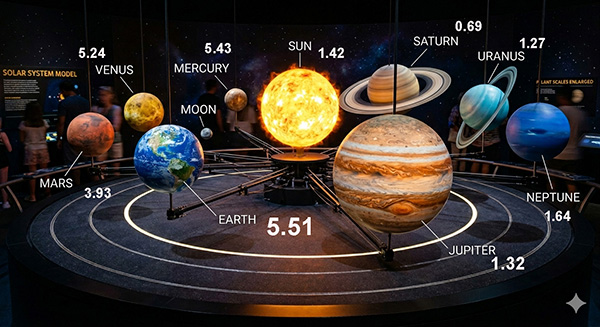
What is the densest planet in the Solar system? The surprising answer is: Earth!
Image: Density shown in grams per cubic centimeter
Out at the cold outer reaches of the solar system, we have the gas giants – Jupiter, Saturn, Uranus, Neptune. These giants jealously hold on to the gases forming their atmospheres, which are the light gases: hydrogen, helium and methane. (The heavy gases are only minimally present.) This makes the gas giants on average fairly light – not very dense. (The atmosphere is included in the overall planet density.)
Jupiter is mainly gas. Indeed, it has more hydrogen than rock-forming elements. Saturn is so light that it would float on water - if it could be placed in some cosmic bathtub!
Mars is not big enough to hold onto its light gases, they drift away (also as a result of heat and low gravity) and it has almost no atmosphere. So, it is denser than all the gas giants.
The Earth is heavier. It has lost its light gases, hydrogen and helium, and retained the heavier nitrogen and oxygen. Earth is also mostly solid elements, particularly iron, and earth's atmosphere contributes little to its overall density.
The inner planets, Mercury and Venus, are much hotter than Earth, and again, iron predominates in their cores. Like Earth they are about 4 times denser than Jupiter. Because of the heat and their modest size and low gravity they tend to have lost their light gases.
The sun itself is about the same density as the gas giants. As a crude comparison, a lump of sun is about the same density as an equivalent size lump of coal !!
All the above densities are in the illustration.
Like the Earth itself, the inhabitants of Earth would have to count themselves among the densest anywhere in the solar system.