How can mathematics work so well?
The Unreasonable Effectiveness of Mathematics in the Natural Sciences is a 1960 article by the physicist Eugene Wigner.
Mathematics can measure with a precision far greater than humans can. No humans can see with their eyes that a million objects is different from a million and one objects. But mathematics can “see” it. Perhaps it is just as my old chemistry teacher constantly said: “Science is common sense made accurate”. And how accurate! Wigner in his article says much the same. Mathematics is something which has to work in the real world, so he thinks that there has been a kind of evolution of mathematics (and physics) in which, almost unconsciously, we have altered or tweaked mathematics so that it does work very well in the real world.
But he trips in doubt over the mathematical/physics use of “i”, which is the symbol for the square root of minus one.
What multiplied by itself equals minus one? Wigner points to common knowledge – there is no such number in maths, or in the universe we experience directly, but in physics it works! For example, without using numbers which involve “i” to calculate various circuit theories, you would not be reading this on a computer. It is also used in describing what happens when light is refracted; passing from air into glass, for example. We are using the unimaginable, the unexperienceable. It gets particularly used when there is repetition, as in a wave. So, is a repeating wave a fundamental part of the universe?
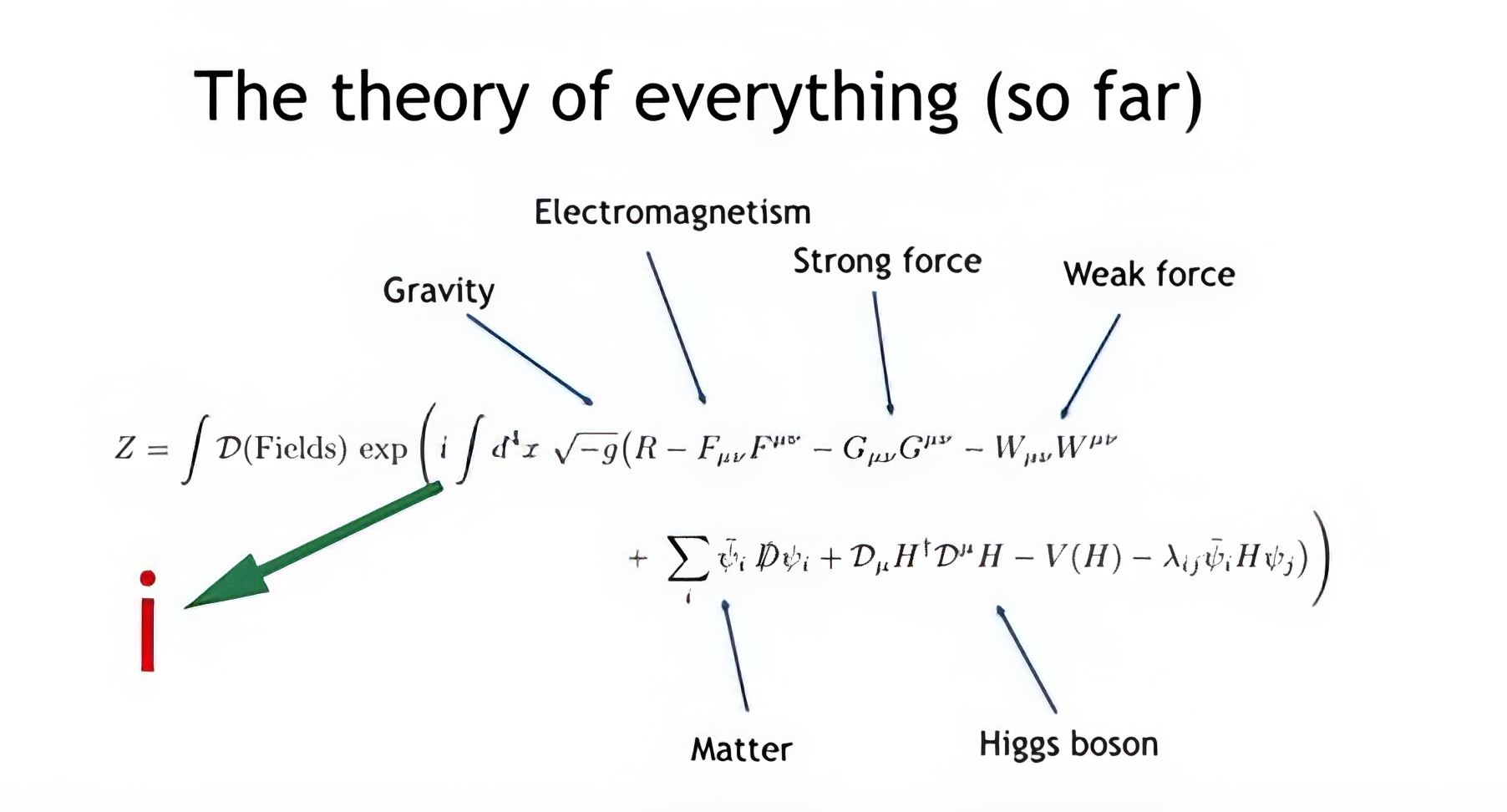
There is an equation of the universe which involves all the forces found so far. To my shock, and perhaps yours, it includes “i”!
If God is light, and light can best be described using these numbers way beyond us, there is a fundamental thing about God which is simply not imaginable. The strange numbers are already a part of the real universe – why should God be any different?