Origins of the days of the week
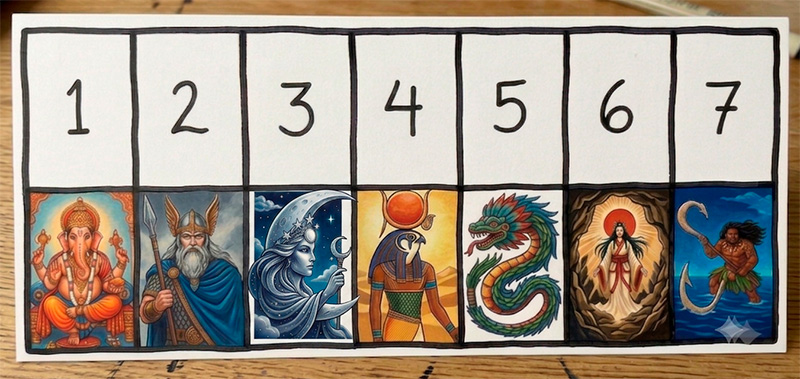
Why do the days of the week have names like Wednesday, Saturday, Sunday? Is that just the English custom? No. For many languages, like Portuguese, the names are numbered Day One day, Day Two, Day Three …
A rough estimate is that 10-15% of all languages use the numbers rather than references to gods or planets. How has this come about?
Very early civilisations found that it was most sensible to have 7 days in a week, 4 weeks in a month and 13 (lunar) months in a year (One rare exception was the ancient Egyptians who said there were 10 days in a week and 3 weeks in a month). Most cultures needed 7 names for the days of the week. They searched for what they should call each day of the 7.
Local gods and 6 visible heavenly planets, plus the sun and moon, seemed be very impressive in many cultures. So they chose various combinations of them and called the days of the week after them. This all seemed very natural.
One nation did something totally different which was really a remarkable secular invention. This nation was the Jews. For the Jews there was only one God and the days of the week were not to be named after false gods. They named their days of the week merely as numbers after the days of creation in Genesis. Each day had a particular focus, things like plants and animals, which really existed, but the days were not named after them. The Jews did not even give religious names to the days of the week, but fixed on numbers alone. This seems to be the clearest example of use of the numerical names from any early culture.
In contrast, the Greeks and Romans named their days after their various gods, and many nations adopted similar labels. The world often followed their pattern, but replaced the names of Greek and Roman gods with the names of their own local gods. In contrast, where Jewish or Christian beliefs took hold, the days followed the numerical pattern. For example, although ancient Greeks used names of their gods for their days of the week, after they became adherents of Christianity, they changed them, and modern Greek day-names became numeric. For ancient Romans the first pattern was their gods, but modern Italy (ironically the home of Catholicism) retains the pagan names for the days. Within the Church, Latin used the numerical form, but it never became the universal pattern in Christian countries.
Internationally there are some surprises in the list of countries which have chosen the numeric system. China since the early 1800’s is one. Mongolia, Vietnam, Persia, Turkey, Russia, Arabic are others. Arabic seems to follow Hebrew closely, but in Arabic, Friday is called a day of gathering for worship. Our Saturday is for Islam a day of rest closely following the example of the Jewish Sabbath.
English speakers have retained links with Scandinavian gods, as have the Scandinavian countries. Of course, the pagan names used in the West are atheistic. However, the Judeo-Christian pattern has left its imprint on about one tenth of the world’s languages.
Within Judaism why were the names of the days not closely tied to the Creator God? Monday could have been a “God-day”! It did not happen. The whole system of days with their numeric names was declared “Very Good” by God in the Genesis creation account so it was copied. The numbers were not gods but part of the abstract and secular realm of numbers and mathematics.
It seems that God endorses mathematics and the realm of the abstract (to the despair of the children who have to learn it!). That mathematical realm has turned out to be vastly more important and widespread than local gods commemorated in the names of days of the week.