Is this the bed of the ancient Pishon River?
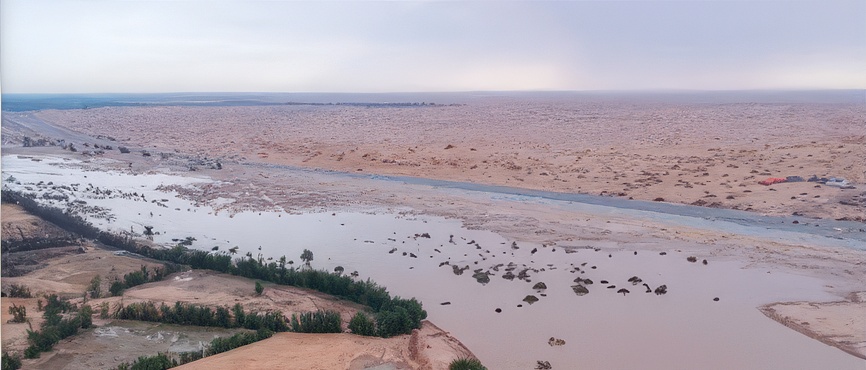
Most scholars don’t believe what I am about to tell you, but nor are they aware of the relatively recent scientific backing for it.
In the book of Genesis four rivers are said to flow out of Eden: the Gihon, Pishon, Euphrates and Tigris. We can find the last two in any atlas and they discharge close together into the Persian Gulf. But where are the first two, Gihon and Pishon? Did they ever exist? Or are they symbolic?
A stumbling point has been that the Biblical text says that the river coming out of Eden divides in four. I don’t know any other river which divides in four. Do you? It’s doubtful there exists a real geographical example. Four rivers easily join, but one river - though it may divide temporarily around an obstacle - usually doesn't separate into three other large river systems.
However, according to some authors the Hebrew text can also mean “divides into four headwaters”. This can be interpreted to mean that four rivers (each with separate headwaters) met at the head of the Persian Gulf near where the Tigris and Euphrates meet today.
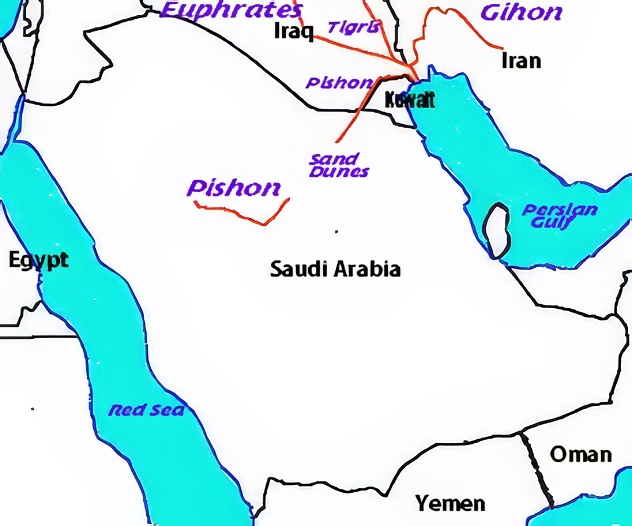
In what follows it will help to look at the map. (The four rivers we are discussing are shown in red.) There is one significant river which joins the Euphrates and Tigris near the Gulf, known today as the Karun river. Its headwaters are hundreds of kilometres away to the northeast in barren mountainous regions in the southwest of Iran. It is the largest river in Iran. I shall temporarily call it the ancient Gihon.
The fourth river, the Pishon, has been a real puzzle. It is described in the Bible as, “... the one that flowed round the whole land of Havilah, where there is gold, and the gold of that land is good; aromatic resin and the onyx stone are there." Why so much description? I think because - when the account was written - the location was no longer obvious.
Havilah in the Bible is between Egypt and Ninevah, which should mean the Pishon is or was on the Arabian peninsula. But where? Indeed, does Saudi Arabia have any rivers at all? Not obviously. Ask AI, and it says there are none, though some flow very briefly after showers of rain.
One possible clue is the identification of minerals like onyx. The exact identification of many of the stones in the Old Testament has been argued over for centuries. However onyx today is well known from Yemen in the southern part of the Arabian Peninsula. It is a black or dark brown kind of onyx and may indicate the presence of the Pishon on the peninsula.
Aromatic resin? Yes, Arabia is famous for it: It is the frankincense of the three kings.
Gold? Yes, there are many goldmines, particularly found in the northwest. The best-known gold mine in Arabia, and one of the oldest is the Mahd ad-Dhahab Mine which translates as “the cradle of gold”.
So there are three pieces of evidence for a Pishon River being in the Arabian Peninsula.
But perhaps there was a communal memory that it had dried up. Rivers depend on the rainfall. The idea that a river once flowed across the deserts of Arabia, meeting the Tigris and/or Euphrates Rivers, draws its evidence from satellite datasets, especially from radar images taken during the 1994 mission of the Space Shuttle Endeavour. In ancient times in some wet conditions there was indeed a river in the Arabian peninsula.
The satellite images show that there was once a major river flowing from Medina at the west of the Arabian peninsula to the Persian Gulf, a total length of 1,200 km. It is now badly sanded up but still has a length of almost 600 km and is called the Wadi-ar-Rumi, or ar-Rummah. (See the top photo.) The river runs from the northwest gold area, across the peninsula. It runs northeast but sinks beneath the sand dunes at about 425 km and emerges on the other side of the desert and is then called the Wadi-al Batin which continues towards the northeast and forms the western boundary of Kuwait. It finally empties into the Persian Gulf. I’m going to call this the Pishon.
Geological studies show that the Wadi al-Rummah flows at full capacity only about three times every 100 years and usually only for several days.
From studies of stable isotopes in sediments it is possible to find when arid or humid conditions existed. Before 4,000 BC there was a long arid period. There was no Pishon then. Since 2000 BC there has been no continuous Pishon. But between 4000 and 2000 BC, drought and wet periods alternated. Sometimes the Pishon existed, sometimes it didn’t.
In the wet periods there was certainly a river that exited into the Persian Gulf about where the other three rivers join it. That means four rivers met in the Persian Gulf right near Kuwait at various times between 4000 and 2000 BC.
If this is correct it is surprising how literal the Biblical descriptions of the Pishon were, with much less allegory than one might expect. The Biblical passage was possibly written while the river sporadically existed, perhaps 2000-4000 BC, which is a very old origin. But perhaps it was written several hundred years later, in which case it the account drew on tradition because at the time of writing conditions were arid and the continuous river no longer existed. Such traditions can remain alive hundreds of years. A tradition 500 years old at the time of writing would bring us to about 1500 BC, about the earliest date proposed for the Exodus.
On this basis any Eden would have been at the edge of Kuwait where the four rivers meet, but with the slow geological sinking of the Persian Gulf through subduction, it would now be deeply buried.
This region seems to have been the area where Saddam Hussein used chemical weapons on the local inhabitants, but the same Biblical account says evil entered Eden long before Saddam Hussein.